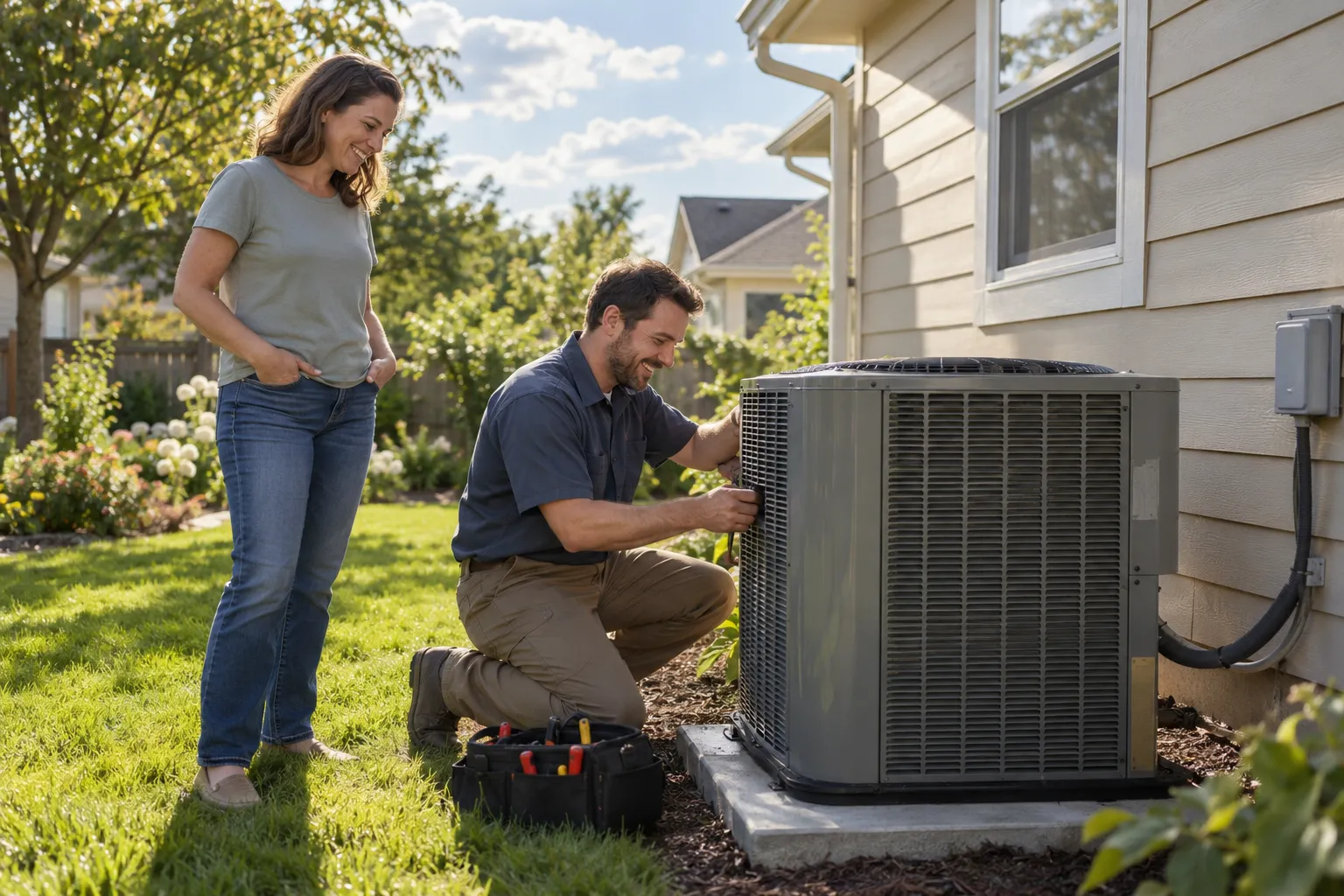
Start Here When Comfort Fails
A dead AC in July or a cold furnace in January feels urgent. Take it one step at a time. This page gives you a short plan.
First, stay safe.
- Smell gas? Leave the house and contact your gas utility or emergency services from outside.
- Hear buzzing, see sparks or smell burning? Turn the system off at the thermostat.
- Water around the unit? Keep clear of electrical parts.
Next, run the simple checks.
1. Confirm the thermostat is set to the right mode and temperature. 2. Check that the breaker has not tripped. 3. Look at the air filter. A clogged one can stop airflow. 4. Make sure vents and returns are not blocked.
Then, get a provider involved. If the checks do not help, a local provider can diagnose the problem. Musicalimportant Heating & Air is a referral service. We do not do the work. We connect you with independent providers in our network.
Request a callback to check provider availability, including for emergency AC repair when a hot house is a health concern.
Request Help
Prefer to write it down first? Send the request form and ask for an estimate. A provider can follow up with questions and next steps.
Request Help
How It Works
What Musicalimportant Heating & Air does
Musicalimportant Heating & Air is a referral service for heating and cooling problems in the Indianapolis city area. You tell us what is wrong. We connect you with an independent HVAC provider who works near you.
The providers are separate businesses. They set their own schedules, prices and work methods. We do not perform repairs, and we do not set the price.
The process in four steps
1. Describe the problem. Request a callback or fill out the request form. 2. Get connected. A provider in our network reaches out. 3. Review the quote. Ask for a written quote that lists the work and the parts. 4. Decide. There is no obligation to accept.
What to have ready
- The type of system: central air, heat pump, gas furnace or other.
- The age of the equipment, if you know it.
- Any noises, smells, error codes or flashing lights.
- What you already checked.
Why the checklist matters
Clear details help a provider plan the visit. They may bring the right parts the first time. Many providers can respond quickly, but availability varies by day, season and workload.
A note on cost
Typical U.S. repair costs range from under a hundred dollars for a small fix to several thousand for a major part or full replacement. Prices vary by job. Always get a written quote.
Serving Homes Across the Indianapolis city area
Homes in the Indianapolis city area come in many styles. Many are frame houses that are decades old. Others are bungalows and ranch homes. Many have full basements, often with sump pumps. Each home type puts different demands on heating and cooling.
Older houses may have tired ductwork or uneven airflow. Basements can hold the furnace, the water heater and the sump pump close together, so a flood can reach more than one system. Ranch homes often have long duct runs across one floor.
The weather here swings a lot. Winters are cold and the frost runs deep. Summers are hot and humid. Severe thunderstorms and hail can hit outdoor AC units. Spring flooding can affect basements.
Providers in our network work with these conditions. Ask each one about your home type, your equipment and the season.
If your system is down, request a callback to check provider availability in Indianapolis city and nearby towns.
Request Help
Want to compare before you commit? Request an estimate and review the written quote at your own pace.
Request Help
A Season-by-Season Plan for Local Homeowners
Spring: after the thaw
First, check the basement for water, especially near the furnace and sump pump. Next, look over the outdoor AC unit for debris, bent fins or storm damage. Then change the filter and ask about a tune-up before hot weather arrives.
Summer: heat and humidity
Humid air makes an AC work hard. Keep the filter clean and the outdoor unit clear of grass and leaves. If the house will not cool, a provider can check the refrigerant, the coil and the fan. Do not wait for a heat wave. Busy weeks fill provider schedules fast.
After a storm
Thunderstorms and hail can dent coils and trip breakers. Turn the system off before you inspect it. Do not touch wiring. Take photos of any visible damage. Some policies may cover sudden damage, so check your policy. Providers can often help document damage for a claim.
Fall: get ready for frost
Fall is a smart time to test the furnace. Run it for a short while before the first hard freeze. Listen for loud noises and note any odd smells. Replace the filter. Fixing a small problem now is easier than in January.
Winter: deep frost
If the furnace stops, check the thermostat, the breaker and the filter. Close doors to keep heat in one area. Never use an oven to heat your home. If you smell gas, leave right away.
When to think about replacement
Repairs add up on older equipment. If the system is old, fails often or costs a lot to fix, ask about furnace replacement near me options or a new AC. Get more than one written quote.
Your first-hour checklist
- Stay safe.
- Run the simple checks.
- Write down what you see and hear.
- Contact a provider.
Ready to Get Started
If your home is too hot or too cold, take the next step now. Request a callback to check provider availability and describe the problem.
Request Help
Not ready to talk? Send a request and ask for an estimate. A provider in our network can follow up, and there is no obligation.
Request Help
You can also email contact@musicalimportant.living with your question.